Blog Feed

Distributed Cognition: Using Technology in ECE Classrooms

I watched the video, “Using technology to support research groups in the early childhood classroom”. The purpose of this video is to show how using technology with learning at such a young age is beneficial. The video explores a preschool classroom using technology as research for topics they are learning. The teacher in the video explains how there are a lot of topics outside of their curriculum that they wish to explore, so she has set time aside for them to do so — their choice, doing their own research, navigating with technology (iPads, laptops, video recordings, taking pictures, googling, etc.).

The class does a research assignment each week. In the morning at the start of the week, the teacher will split students into three groups. Each group is assigned a topic to research on. In the video, the three topics were cats, dogs, and alligators. Throughout the week, they work on researching information on the topic. At the end of the week, each group will share out to the class what they learned. The teacher, Yeliz Zurawic, emphasizes that it is her goal to for students to relate what they are learning in the classroom to the outside world/their own experiences. The video showed one student in the ‘cat’ group discussing how her cat moves her tail just like it does in the research she found about cats tails.

Zurawic states in the video that research should not be limited just through books or just through technology. There is a good mix of using both resources — some information may only be found in certain books while some information can only be found online. It is important to remember to not limit oneself when researching, that there are various resources and tools all around. This can relate to the actual concept of distributed cognition that proposes cognition and knowledge are not confined to an individual, but distributed across objects, individuals, objects, artifacts, and tools in the environment.

It was interesting to see kids at the preschool level working with technology and researching information. I think this type of learning really benefits them because they will take these skills and apply/use it for years to come. To answer the question of, “Will this lesson and how technology is integrated make the students smarter? If so why? If not, why not?”, I believe this lesson will make the students smarter. As teachers, we need to recognize that times are changing and technology use will be implemented in all classrooms/grade levels. I think that this way of integrating technology is beneficial to them because they are learning and becoming familiar with online research. They will see technology not just as for playing games or watching TV, but for educational purposes as well.

Assessment for Digital Story

Criteria: 4) Exceeds criteria (3) Meets all criteria (2) Meets some criteria (1) Does not meet criteria

*Students who go above and beyond just the established criteria will receive extra points. If a student has met all criteria, they will receive a score of 18. If they exceeded criteria, they can earn a score up to 24.

Research:

Was the story well researched and well documented? 3

Organization: 

Was the story easy and engaging for viewers to follow? 3

Did the events in which they were placed in the story make sense and flow? 3

Presentation and Performance:

Did the student correctly utilize transitions? 3

Additionally, did the student include special effects (sounds, movements, etc.) 2

Citations and Permission:

Do citations appear in the format required by the project? 2

Total Points:  16 / 18

Digital Story: Link and Credits

Link to video: https://www.wevideo.com/view/1638284395

Since our video cut out our credit clip at the end, here are the links to the poem and images we used in the video below:

Poem: 

Image 1:

https://www.nationalgeographic.com/news/2015/1/150109-oceans-plastic-sea-trash-science-marine-debris/

Image 2: 

https://www.nationalgeographic.org/article/heres-where-oceans-trash-comes/

Image 3: 

https://phys.org/news/2017-11-trash-islands-central-america-ocean.html

Image 4: 

https://www.pri.org/stories/2015-02-22/forget-floating-pacific-garbage-patch-new-trash-entering-oceans-much-worse

Image 5: 

https://www.mnn.com/earth-matters/translating-uncle-sam/stories/what-is-the-great-pacific-ocean-garbage-patch

Image 6: 

https://www.pbs.org/newshour/science/the-great-pacific-garbage-patch-weighs-more-than-43000-cars-and-is-way-bigger-than-previously-thought

Image 7: 

https://climate.nasa.gov/effects/

Image 8:

https://climate.nasa.gov/solutions/adaptation-mitigation/

Image 9: 

https://www.edf.org/climate/why-fighting-climate-change-so-urgent

Image 10: 

https://www.jasa.nl/about-jasa/how-to-recycle/?lang=en

Image 11:

https://www.trashcanswarehouse.com/Recycle-Bin-I-Outdoor-Station_p_1429.html

Image 13: 

https://www.discovermagazine.com/environment/are-you-an-aspirational-recycler-heres-9-things-you-actually-cant-recycle

Image 14: https://www.nytimes.com/2018/05/29/climate/recycling-landfills-plastic-papers.html

Blog Post #9: Digital Storytelling Assessment Rubric

Digital Story Assessment Rubric

Criteria: 4) Exceeds criteria (3) Meets all criteria (2) Meets some criteria (1) Does not meet criteria

Story:

How well does this story work? ___

Research:

Was the story well researched and well documented? ___

Writing:

What was the quality of the student’s written work? ___

Organization: 

Was the story easy and engaging for viewers to follow? ___

Did the events in which they were placed in the story make sense? ___

Presentation and Performance:

How effective was the student’s actual presentation? ___

Did the student correctly utilize transitions? ___

Additionally, did the student include special effects (sounds, movements, etc.) ___

Citations and Permission:

Do citations appear in the format required by the project? ___

Has everything that is not original been credited? ___

Total Points:  ___ / 40 

Blog Post #9: Technology Access in Noble Elementary

Mentioned in previous blogs, my field observations took place at Noble Elementary in Cleveland Heights. Unfortunately with the chaos of events happening currently, my cooperating teacher has yet to respond to my email about their technology usage at school. I decided to look on the school’s website for any information regarding technology, as well as recalling what I have experienced for the few times I was in the classroom.

Here’s what I found:

The Noble Library has a Library Media Ancillary — someone who provides support to the primary activities of an organization, institution, or industry. In this case, the ancillary works specifically in the library media to help people with problems/questions they have about online resources (magazine databases, newspapers, other purchased digital resources). For convenience, the library offers an online “Noble Library Catalog”. They also provide a link to access elementary online resources — all found on the library website.

The students are assessed through MAP testing three times per year. Measures of Academic Progress (MAP) “is a state and nationally aligned program that provides CH-UH educators with the information that they need to improve teaching and learning and to make student-focused, data-driven decisions”. This test is taken on the computer. It generates the test questions based on students’ responses and adjusts to a students’ skill level so that each student takes an individualized test. Noble has a data, research, and assessment staff that specifically works in preparing for MAP testing: director of data, research, and assessment, administrative assistant, application specialist, and a systems analyst.

Noble takes advantage of online websites for school such as Google Classroom, Clever, and IlluminateEd. The links to these programs were listed on their website. I clicked on them and it took me to their sign-page, so I imagine every teacher, parent, and student have their own account. They also take advantage of Parent Portal, an online source for parents to access their child’s grades, attendance, etc.

There is a supply list provided on their website with a list of materials that students need for the year. One of the materials were headphones/earbuds for their iPads. I imagine the school provides classroom iPads or a place in the school where you are able to rent them out for a time period. During my time in Mrs. Bruce’s classroom, she had a cart of chrome books which the students use frequently throughout the day.

Overall, the usage in technology at Noble Elementary seems to be used quite frequently. Observing in the classroom, the students were familiar and engaged with the technology they were utilizing. I assume that the school provides all of the technology to their students, although there may be some fees that families have to pay in order for them to have access.

Digital Storytelling Script and Storyboard: How we can change the world (UNREVISED)

If I could change the world, I would…

How our trash impacts the environment 

WILDLIFE

  1. There is more plastic than fish!
    1. Eight million metric tons: That’s how much plastic we dump into the oceans each year. That’s about 17.6 billion pounds — or the equivalent of nearly 57,000 blue whales — every single year. By 2050, ocean plastic will outweigh all of the ocean’s fish.
  2. Most ocean trash sits at the bottom of the ocean.
    1. 70 percent of ocean garbage actually sinks to the seafloor, meaning we’re unlikely to ever be able to clean it up.
  3. The number of dead zones is growing.
    1. In 2004, scientists counted 146 hypoxic zones (areas of such low oxygen concentration that animal life suffocates and dies) in the world’s oceans. By 2008, that number jumped to 405. In 2017, in the Gulf of Mexico, oceanographers detected a dead zone nearly the size of New Jersey — the largest dead zone ever measured.
  4. The oceans are losing mussel mass.
    1. One effect of greenhouse emissions is increased ocean acidification, which makes it more difficult for bivalves such as mussels, clams and oysters to form shells, decreasing their likelihood of survival, upsetting the food chain and impacting the multibillion-dollar shellfish industry.

CLIMATE CHANGE

PUBLIC HEALTH

Human health is at risk through our inaction. We keep producing large amounts of trash, we do not dispose of it correctly, and in the end that will be our downfall as it is for the environment and wildlife in the ecosystems we all share. We cannot prevent or promote longevity with how we treat our Earth. The more emissions that we produce due to how much trash we generate, affects us long term. One can develop diseases such as asthma, birth defects, cancer, cardiovascular disease, childhood cancer, COPD, infectious diseases, low birth weight, and preterm delivery. Bacteria, vermin and insects can also be added to the problem that trash causes.

HOW WE CAN CHANGE THE WORLD 

RECYCLE!

*Recycling noise of throwing a bottle in the recycling can*

Recycling is the access or process of converting waste into reusable material. 

There are different ways to recycle your bottles, plastic, metal, and glass.

The recycling materials are taken to a plant and they are sorted and then cleaned and reused with different products.

-Fade in-

Now, specifically in Cleveland, we have to recycle our used products. They gave us a new bin to put our recyclables in. 

*Garbage truck noise.*

Recycling can help Earth not be filled with trash that can be reused. 

Instead of throwing your paper, bottles, or plastic into the trash, think about the different ways they can be reused into new products! Take the small extra time to find a recycling bin (which is usually right next to trash cans). 

Recycling is a small act that makes a huge impact! 

Another way we can help change the world is by planting more trees. 

Trees cleanse the climate and release oxygen into our atmosphere. 

They provide an abundance of benefits to us and our world, everyday. 

We can plant trees in our neighborhood *digging noise*

This way we can prevent all of our trees getting taken down

We get oxygen from our trees and we need oxygen to breathe.

Planting trees is a great way to give back to our planet.

This is a way to make our Earth more green and a way to come together as a community

In grade school we posted trees on our grade schools lawn because they had to cut old dead ones home

This can be a science project for younger grades to help make sure there are trees for new generations

Deforesting is a huge issue with the rainforests because we need the resources for paper products and wooden products.

If we tear trees down without replanting them our earth will start dying because we need the trees and plants

Benefits of Recycling

  • Reduces the amount of waste sent to landfills and incinerators.
  • Conserves natural resources such as timber, water and minerals.
  • Increases economic security by tapping a domestic source of materials.
  • Prevents pollution by reducing the need to collect new raw materials.
  • Saves energy.

Recycling and planting new trees is a great way we can help the earth and change the world.  As students we need to set an example that others can follow because planting trees and recycling seems like a small change but in the long run it will make a huge impact

Poem about changing the world:

How can we change the world?

Change the way that things are?

What will it take?

What have we done so far?

Are we calling for kindness?

Are we learning together?

Are we leaving a legacy?

We’ll be proud of forever?

Do we care about others?

Do we try to understand?

Could we unite the globe?

Every place, every land

Every single last person,

All residents by birth.

It’s in our best interests

To cherish our earth.

So, what are we doing?

Will it ever be done?

Can we craft a better future

For the generations to come?

Can we nurture all spirits

Between ocean and sky?

Can we change the world?

We can certainly try.

By: MS Moem

Field Placement Reflection

This semester, I was placed at Noble Elementary in Cleveland Heights. I am observing/participating in a third grade math classroom. My cooperating teacher is accommodating to me and well-informed on what to expose me to as a future educator. So far, I have done tasks such as grade papers, compute students’ test scores (data), aid students in math activities/worksheets, and organize students’ notebooks. There are times when I am able to observe and work with students, and other times where I am assisting the teacher in certain tasks such as the ones mentioned. I find both instances to be beneficial where I am excited to continue my visits for the remainder of the semester. 

I am able to observe in the classroom in the mornings until the afternoon. The students usually start off their mornings with bellwork that the teacher writes on the board. After they complete their bellwork, the teacher gathers the students on the rug to have a morning meeting. In this meeting, the teacher will give them a schedule about their day and discuss any events or exams coming up. After the meeting, announcements come on and that is an indicator to start their day. The class breaks off into several groups, going to different classrooms. A few students stay back, working on assignments from the previous day or catching up on work. They stay in these groups for 45 minutes then come back as a whole, where the teacher then starts her lesson for the day. I suppose this is an example of a small group experience, although I did not get to witness how the students who traveled to other classrooms interacted with each other. As for the students who stayed back, the dynamic seemed to be very casual and independent driven. I witnessed some of them bouncing off ideas from each other and asking questions, but they were all working at their own pace. Another instance that I witnessed small group interaction is between the teacher and students. After teaching the lesson, the class will break off into work. During this time, the teacher will call 4 to 5 students to her desk to work on an assignment. Doing this allows for students to learn more comfortably, in a smaller setting and being able to see things more closely. Groups are called up to her desk one at a time, while the rest of the class works on an activity independently. 

The different types of technology I have witnessed being used in the classroom are the SmartBoard and laptops. The teacher utilizes the SmartBoard as a whole class, where the laptops are used individually by the students. I have not witnessed any specific programs being used on their laptops. During math, their work is majority done with paper and pencil (worksheets/handouts, notebooks). Although I am only in the classroom two hours out of the whole school day, I have witnessed little technology use among the students during my time there. I asked a handful of students how often they use technology outside of the classroom, and if they have any of their own devices. Many students have their own tablets or use their parents phones for games and movies. Being in third grade is a young age to have social media accounts, although some students did report having them under parental guidance.

Video Game Exploration: Final Thoughts

Education.com consists of many educational games varying with subject. As an Early Childhood major, I can see myself implementing many of these games into my future students’ learning. They are user friendly, engaging, developmentally appropriate, and provide learning standards and instruction on how to incorporate these games into your lesson. One of my favorite features is that it tells the user what grade level the game focuses on so it is helpful for the teacher to choose what to introduce to their students.

The games are short, but effective. There are so many games to choose from that you could even allow students to play more than one depending on the topic. Reading, spelling, counting, fractions, vowels, sentence fragments, you name it — education.com has it.

Video Game Exploration #3: Less Than or Greater Than

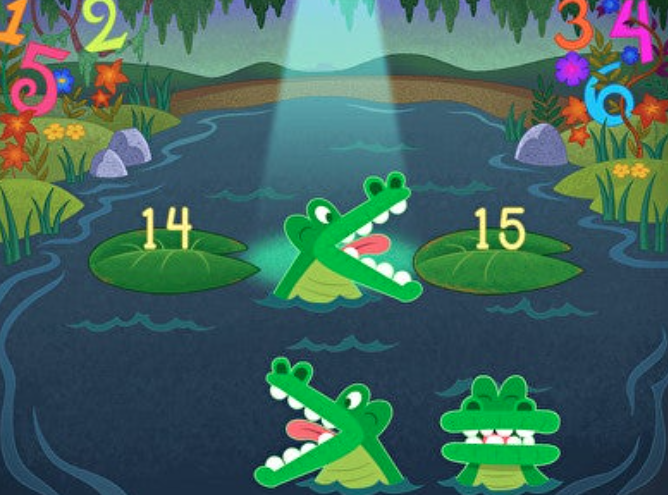
Another game from education.com, called Less Than or Greater Than, challenges players in identifying between less than and greater than numbers 1-20. The setting of the game takes place in a pond. There are vibrant colors and sounds to attract the kids and keep them engaged. As you can see pictured below, the alligators mouth acts as a greater, less than, or equal to sign. There are two lily pads on each side of the alligator with numbers sitting on top of them. Students will choose which mouth is pointing towards the larger of two numbers. This game works number sense with two-digit numbers.

This game is focused towards the 1st grade level. I think this is an appropriate game for that age as it is easy to navigate, and acts as great practice for young students.